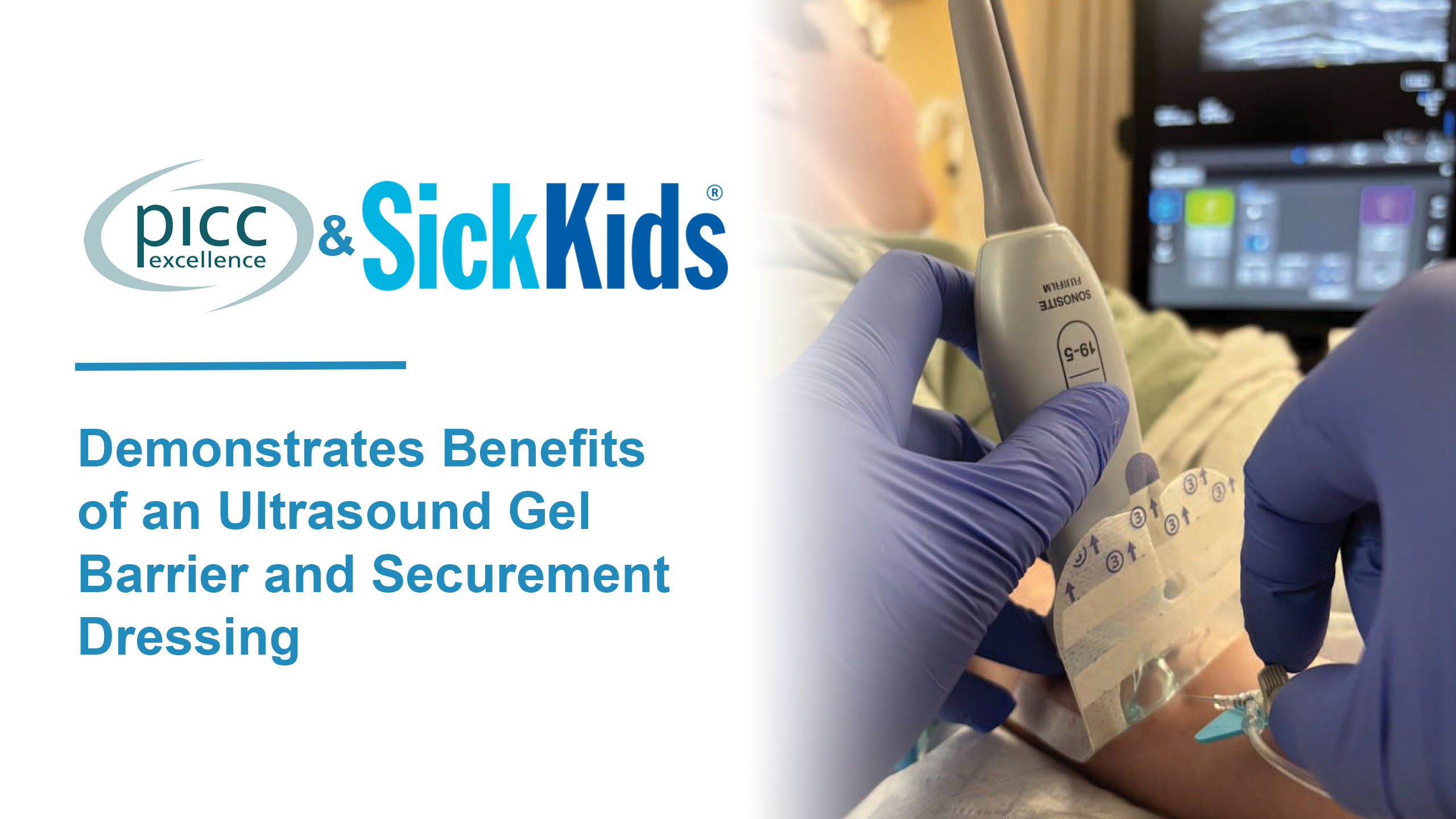
PICC Excellence and SickKids Project Demonstrates Benefits of an Ultrasound Gel Barrier and Securement Dressing
Standardized protocol for ultrasound-guided IV insertion improves
aseptic technique, efficiency, and consistency in pediatric care
HARTWELL, Georgia—PICC Excellence today announced findings from a quality improvement project conducted at the Hospital for Sick Children (SickKids), in Toronto, Canada, and presented at the recent World Congress on Vascular Access (WoCoVA), in Valencia, Spain.1
The project demonstrated how incorporating an integrated barrier and securement dressing into ultrasound-guided peripheral IV (UGPIV) insertion procedures can significantly improve adherence to aseptic non-touch technique (ANTT); streamline clinician workflow; and support standardized, evidence-based practice.
Guided by clinical practice and quality lead Nigel Ruse, RN, MN, and clinical nurse specialist Sarah E. Gallie, RN, MN, with the collaboration of PICC Excellence CEO Nancy Moureau, RN, PhD, the project evaluated baseline and post-implementation UGPIV insertion practices performed by SickKids clinicians. The initiative was driven by recently updated Canadian Vascular Access Association guidelines emphasizing the need to implement ANTT techniques, and by observed variability in clinical practice—particularly around probe-related contamination and inconsistent aseptic technique.2
“Healthcare teams are under pressure to deliver safe, consistent care while managing time and resources,” says Moureau. “This project shows that when teams introduce a protective ultrasound gel barrier and securement dressing into a standardized ANTT approach, they can achieve meaningful improvements in both safety and efficiency.”
From Variability to Standardization
The gap analysis performed by the SickKids vascular access team identified opportunities to strengthen aseptic practice across multiple points in the UGPIV insertion procedure, addressing observed variation in how asepsis was maintained from preparation through insertion and securement.
To confront these challenges, the team implemented a multicomponent intervention centered on an integrated probe protection barrier and securement dressing, combined with targeted education on ANTT principles, workflow redesign, and real-time clinical coaching.
“The goal wasn’t just to introduce a new product, it was to standardize the entire process,” Gallie explains. “The UGPIV barrier and securement dressing helped us reduce complexity and eliminate key sources of contamination, but to be effective it had to be combined with strong fundamentals like hand hygiene and proper aseptic technique.”
Dramatic Improvements in Aseptic Performance
Post-implementation results showed substantial gains across multiple measures of ANTT adherence. Most notably, avoidance of probe contamination of the insertion site increased dramatically, from just 9% at baseline to 86% following implementation.
“These are meaningful improvements in practice that directly affect patient safety,” says Moureau. “The probe is a known vector for contamination, and protecting the key site is essential. The UGPIV barrier and securement dressing improves aseptic technique by providing sterile probe protection and separating ultrasound gel from the prepared insertion site.”
The project also demonstrated broader gains in compliance with aseptic technique, reflecting the value of a standardized, systemwide approach. “By reducing variability, SickKids created greater consistency and policy compliance, driving safer outcomes,” Moureau adds.
A Keystone for Workflow Efficiency
Beyond safety, the dressing emerged as a critical enabler of workflow efficiency. Traditional approaches to maintaining asepsis during ultrasound-guided insertions often require multiple components, including sterile probe covers, sterile gel, and sterile gloves—all of which add time, cost, and complexity.
In contrast, the dual-action barrier and securement dressing simplifies the process by combining probe protection and site coverage into a single step.
“Once clinicians became comfortable with the dressing, they saw immediate value,” says Gallie. “It eliminates several setup steps and reduces the need for additional supplies, making the procedure both faster and more efficient.”
Moureau describes the UGPIV barrier and securement dressing as a keystone in the redesigned workflow. “It pulls everything together—efficiency in time, efficiency in cost, and consistency in ANTT application. Without it, standardization would have been challenging to achieve within all departments and across all the clinicians performing the procedure.”
“More patients receive ultrasound-guided insertions when the procedure is performed in a time-efficient and standardized manner,” says Moureau. In pediatric settings, where procedure time directly affects patient experience, such efficiencies are especially valuable. “Reducing procedure time can significantly decrease distress for children,” she adds. “That’s an important and often overlooked benefit.”
Balancing Innovation with Best Practice
In the WoCoVA presentation, Gallie emphasized that while the UGPIV barrier and securement dressing plays a central role, it is not a standalone solution. Instead, it functions as part of a comprehensive ANTT-based protocol.
“You can’t rely on any single intervention to solve all aseptic challenges,” says Gallie. “But when the dressing is used alongside proper hand hygiene, skin antisepsis, and a defined aseptic field, it becomes a powerful tool for reducing contamination risk.”
Such an integrated approach aligns with a growing focus on evidence-based standardization in vascular access. According to Moureau, the study provides a scalable, transferable model that applies to all departments using ultrasound to guide peripheral insertions.
“What SickKids has demonstrated is a practical, reproducible strategy that can be applied across both pediatric and adult settings,” says Moureau. “It’s about simplifying practice while efficiently strengthening safety.”
AVA Presentation for North American Audience
The SickKids implementation study results have been accepted for presentation at the upcoming annual scientific meeting of the Association for Vascular Access (AVA), 2–4 October 2026, in Grapevine, TX. The poster, “Standardizing Aseptic Practice in Ultrasound Guided Peripheral IV Insertion Using an Integrated Probe Barrier: A Quality Improvement Initiative,” will be the first presentation of the SickKids study results for a North American audience.
About the Hospital for Sick Children (SickKids)
The Hospital for Sick Children (SickKids) has been changing the game for pediatric healthcare since it became the first children’s hospital in Canada in 1875. Affiliated with the University of Toronto, SickKids is one of Canada’s most research-intensive hospitals and has generated discoveries that have helped children globally. Its mission is to provide the best in complex and specialized care; promote a culture centered around patient and family experience; pioneer scientific and clinical advancements; foster an academic environment that nurtures healthcare professionals; and champion an accessible, comprehensive, and sustainable child health system. For more information, visit www.sickkids.ca.
About PICC Excellence
PICC Excellence Inc. is an educational service for clinicians. The firm is a leader in vascular access education and provides a support network and continuing education credits for vascular access professionals who insert or manage peripheral and central venous catheters. For more information, visit www.piccexcellence.com.
References
1. Ruse N, Gallie SE, Moureau N. Standardizing Aseptic Practice in Ultrasound-Guided Peripheral IV Insertion Using an Integrated Probe Barrier: A Quality Improvement Initiative. Poster presented at the 2026 World Congress on Vascular Access (WoCoVA), Valencia, Spain, 15–17 April 2026. Available at: www.parkerlabs.com/standardizing-aseptic-practice-in-ultrasound-guided-peripheral-iv-insertion-using-an-integrated-probe-barrier-a-quality-improvement-initiative-sickkids-wocova-2026.
2. 2024 Canadian Vascular Access and Infusion Therapy Guidelines. 2nd ed. Hamilton, ON, Canada: Canadian Vascular Access and Infusion Therapy Guidelines, 2025. Available at: https://cvaa.info/en/guidelines/cvaa-guidelines-2024.
[FIGURES]
Figure 1. An integrated barrier and securement dressing protects the insertion site while enabling ultrasound-guided procedures. Source: SickKids (Toronto, Canada).
Figure 2. Results from the SickKids quality improvement project showed substantial gains across multiple measures of ANTT adherence. Source: SickKids (Toronto, Canada).
Figure 3. Removing the film layer from the integrated barrier and securement dressing allows for clean, residue-free gel removal. Source: SickKids (Toronto, Canada).